Before you call
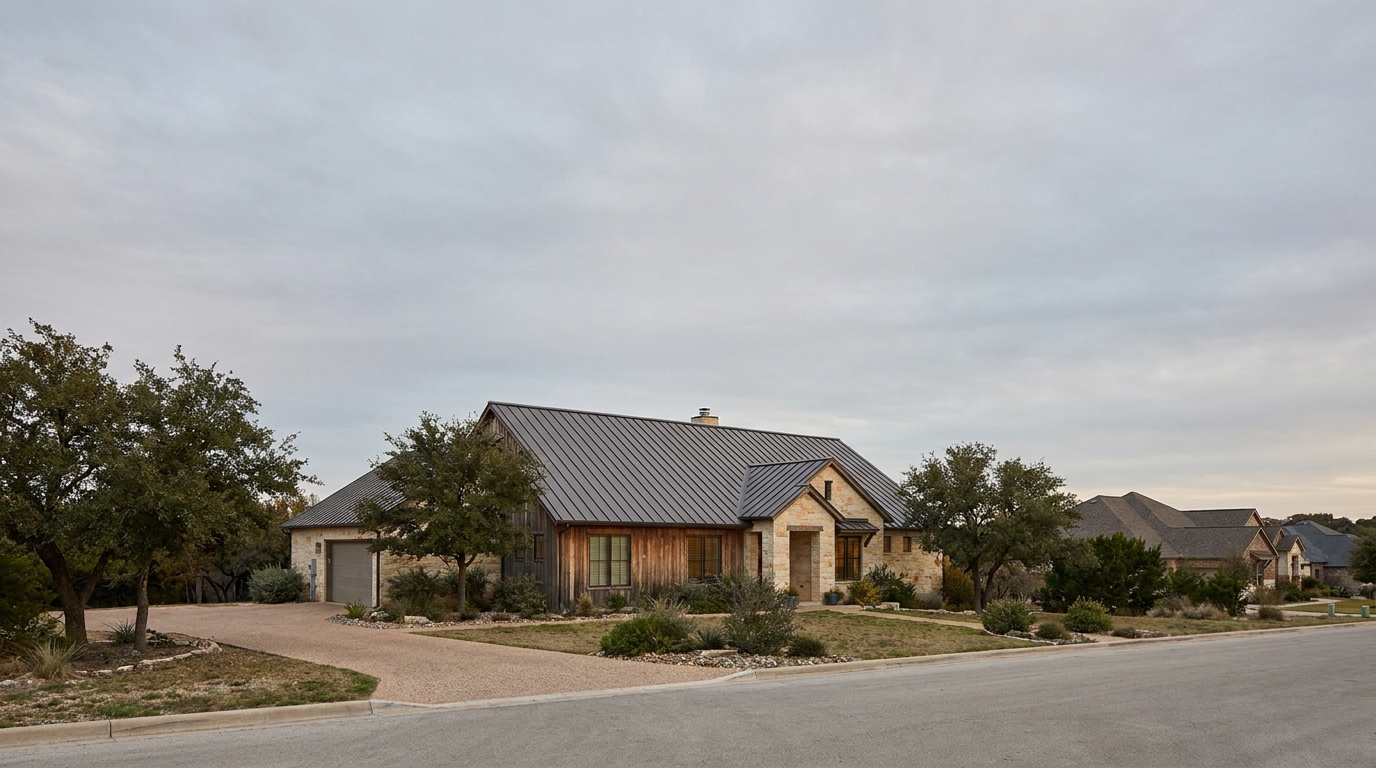
Why metal rather than shingle?
In this part of the Hill Country it is usually about hail and heat rather than looks. We will tell you where shingle is the better answer for the money, because on plenty of roofs it is.
Replacement
Is this roof actually at the end?
A roof is replaced once. This page is what that decision rests on, and what a replacement has to get right underneath the part you can see.
Not what you are looking at? Storm Damage, Hail Damage.
Condition and age
Age alone does not condemn a roof and a bad season does not either. What decides it is condition across the whole plane, and that is established by looking.
A replacement is a system, not a surface. The parts under the visible layer decide whether it lasts.
Before the tear-off
A replacement quoted without going up is a guess. The survey decides the scope, and the scope decides everything else.
The work itself
Complete tear-off and replacement of the covering, with the deck, underlayment, flashing and ventilation renewed as one system rather than a new surface over old problems.
What you are left with
Every finding is photographed before anything is touched and again once the work is done. You keep both, whatever you decide to do next.
What you are actually buying
The covering is the part you can see and the part everybody quotes on. Whether the roof lasts is decided by the four layers underneath it and by every junction where they meet something else.
The only layer you can see from the ground, and the one that takes the weather. When somebody says a roof looks fine, this is what they are looking at.
A water-resistant layer laid over the deck before the shingles go on. It is the second line: what keeps water out when wind drives it under the covering.
Metal at every junction — where the roof meets a wall, a chimney, a vent, or itself in a valley. A great many leaks are a flashing detail rather than a failed shingle.
The structural sheathing everything above is fastened to. Once water has been sitting on it, the repair stops being a surface job.
What carries the load, and the airflow that keeps the underside of the deck dry. Ventilation problems tend to show up as roof problems years later.
Asked about this job
Before you call
In this part of the Hill Country it is usually about hail and heat rather than looks. We will tell you where shingle is the better answer for the money, because on plenty of roofs it is.
The next step
Worth an hour of somebody's time to be sure it's the right call, and to find out what's under the covering before anybody quotes on replacing it.
Cedar Park · Lakeway · Leander